
The Beginning of Raising Baby Bilingual
- Charlotte BULKELEY CREDLE

- Jun 17
- 3 min read
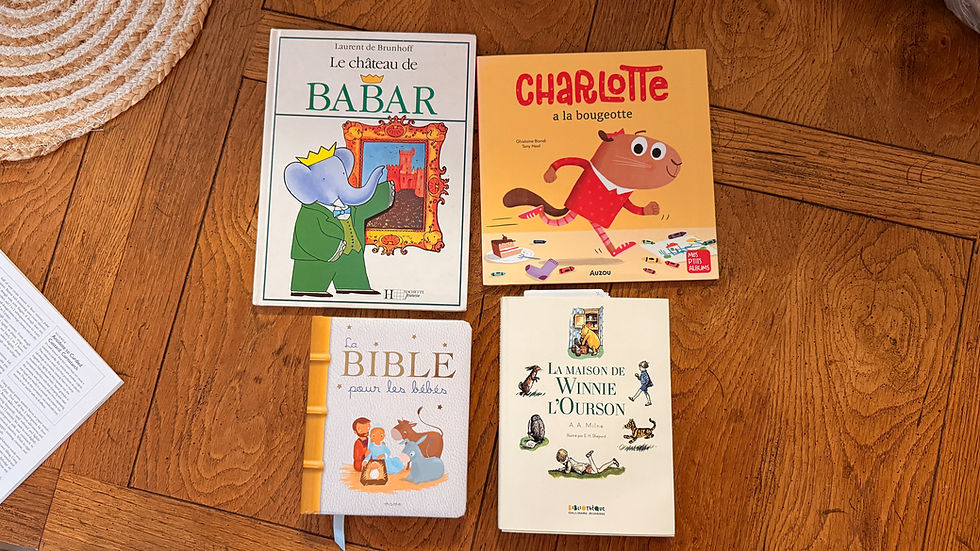
Six months ago, my husband and I welcomed our first baby! The learning curve has been steep and as we have more and more gotten our feet back under us, we are beginning to integrate French into our everyday interactions and routines. Raising our baby bilingual is our goal.
This is a new endeavor in my own bilingual journey - that of passing on my French to my baby. I have to remind myself that consistency will pay off even though we live in an English-dominant community and my husband does not speak French.
We'll be using a mix of two strategies: One Parent, One Language (OPOL) and Time and Place (T&P). OPOL is most often used when the parents have different native languages. It's employable by non-native speakers where, for example, a French mother speaks only French and an American father speaks only Englihs to the child. This can lead to a few fascinating outcomes. For example, the child eventually associates French things/vocabulary/experiences/emotions with his mother and vice versa with his American father. But with my own limitations, I'm also going to be using T&P since both my husband and I are American. T&P allows the parent to pick a time and/or a place to use the second language (L2) rather than attempting to (and unfortuantely probably failing to) use the L2 100% of the time. T&P will give us structure and a roadmap for days when English is just more needed.
Two people that put out helpful content and literature on raising bilingual babies are Michelle (@bilingualcoco) and Suzanne Barron-Hauwert (LinkedIn).
Michelle's account documents her experience teaching her children French and uses her background in linguistics and cognitive psychology to explain the process of becoming bilingual and how other parents can do the same with their kids. Her content where she recounts different Franglish words her children use and ways she sees them actually acquiring French are particularly motivating that it is possible (and so much fun) raising your children in your second language. Another reason why I find Michelle's account so helpful is because she and her husband are also both American. Thank you, Michelle!
Suzanne Barron-Hauwert is an author and researcher on bilingual families. Her book Language Strategies for Bilingual Families: The One-Parent-One-Language Approach (2004) is an overview on OPOL and a collection of case studies for each age range. She also includes a section on T&P. One particularly helpful section begins on page 99 where she discusses how to keep using the L2 when there are other non-L2-speaker with you. She offers a couple different solutions and so far, I am going to try speaking French to my child if it is a one-on-one interaction between us in a group/public setting and English to the others present. Barron-Hauwert explains that one benefit of this solution is that you still model appropriate manners and can coach your child through social situations in both languages. This parenting benefit outweighs the "con" of using the second language in all situations and makes raising bilingual children more practical, especially for non-native L2 parents. Thanks, Suzanne!
I'm documenting this for my own accountability and to keep track of how things are progressing. My own experience learning French took so much effort and is an everyday process still. I still look up words all the time and feel very un-fluent for a C1 speaker BUT that is the case for so many of us second language speakers and does not at all mean that we are not "fluent enough." I am so excited to share this language with my child.
Most recently, we have been using OPOL when my husband is at work during the day and T&P for mealtimes and playing in the living room floor. We read as much as possible, multiple times throughout the day and love the Babar books (you can find them usually on eBay).
Finally, a few words I've had to look up that I use all day every day:
diaper: une couche
change/put on a diaper: mettre une couche à
wipe: une lingette
pack of (baby) wipes: paquet de lingettes (pour bébé)
onesie: une grenouillère
sleep sack/swaddle: une gigoteuse (can also mean sleeping bag).
don't eat that: ça ne se mange pas
Consistency is key! Bon courage,
Charlotte


Comments