
Nursing, teething, crawling, and starting solids while Raising Bébé bilingual (French words for six month old baby development)
- Charlotte BULKELEY CREDLE

- 4 days ago
- 3 min read

C'est une semaine mémorable chez nous. Notre bébé a commencé de ramper. Chaque jour, elle marche un peu mieux à quatre pattes en jouant sur le tapis. Elle téte bien toujours, particulièrement après qu'elle fait la première sieste du jour et avant qu'elle se couche pour la nuit. Ces sont parmi les moments les plus tendres de mon expérience maternel jusqu'ici. Il faut que je sois régulière dans le tirage de mon lait parce que je veux bien avoir une bonne collection dans le congélateur. On commence aussi il y a une semaine la diversification alimentaire/DME! C'est un peu intimidant mais elle aime beaucoup manger, donc pour ça, je suis reconnaissant. Il semble qu'elle aime mieux la patate douce.
Voici le vocabulaire pour nursing, teething, crawling, and starting solids while Raising Bébé bilingual (French words for six month old baby development):
crawling - ramper, marcher à quatre pattes
breastmilk - le lait maternel
nursing/breastfeeding - donner le sein (when mom is subject), téter* (when baby is subject), l'allaitement (when using it as noun, i.e. "nursing is difficult," is l'allaitement est difficile)
pumping - tirer son lait
take a bottle - boire au biberon, téter son biberon (biberon can also be the bottle contents)
*téter can also be used as slang to say someone is "knocking back" a drink.
take a nap - faire la sieste
be sleepy - avoir sommeil
i'm right here - je suis là
teething - faire ses dents (used more when a tooth has already come in)
have a tooth coming in/breaking through - avoir une poussée dentaire
teether toy - anneau (ring)/jouet de dentition
starting solids - commencer la diversification alimentaire
solids (foods) - aliments solides (solides is an invariable noun so we done have to worry about adding/taking away -e because aliments is masc.)
baby-led weaning (BLW) - la diversification menée par l'enfant (DME), le sevrage dirigé par l'enfant
purees - la purée
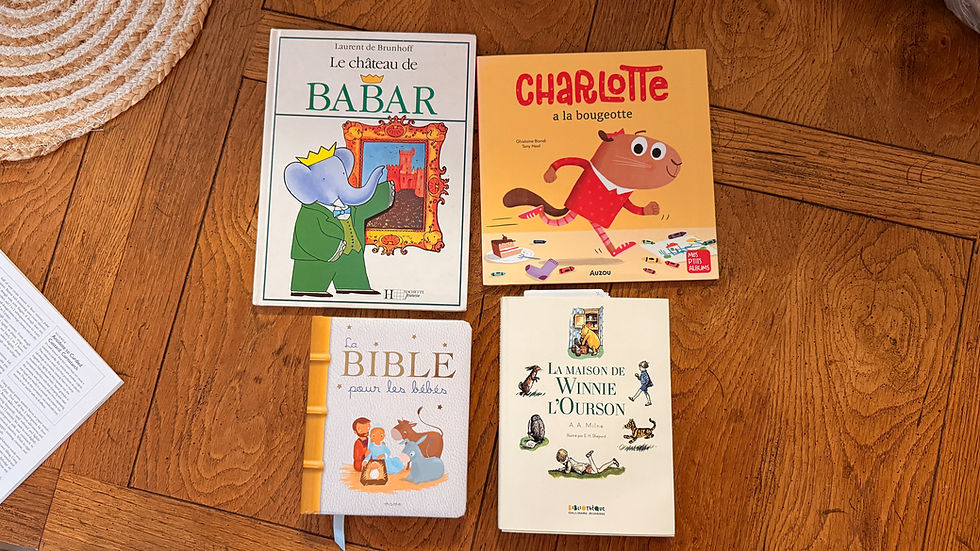
Our book of today is a favorite that we read a lot: l'Histoire de Babar le petit éléphant par Jean de Brunhoff. Michelle (@bilingualcoco) over on instagram has a guide to buying French language books. My go-to's are amazon and ebay, but check out her step-by-step guide.
Why is reading so important? "Home literacy practices that support language and literacy development in bilingual children: a longitudinal case study" is a great study led by Dacien Dolean that explains that there are four major benefits to reading aloud to bilingual children:
Consistent exposure to the language.
Vocabulary that rarely comes up in everyday routines.
Positive emotional associations with the language through cuddling, bedtime, and shared attention.
A bridge to later independent reading, which dramatically increases the amount of language input a child receives.
In other words, babies love repetition and reading and rereading is the perfect way to work that into your bilingual day. As you baby grows, he'll be able to read the same book to himself and build on the scaffolding exposure he gained during your reading time with him. His brain will have also encoded emotions with the experience of reading and communicating in the language that is probably harder to use. I see this already with my 6-month-old. My baby loves sitting in my lap, looking at the detailed and colorful illustrations, and listening to the rise and fall of the French sounds she doesn't yet understand. Reading gives me a good break from the stream of conscious narration throughout the day that my own English-dominant brain needs sometimes.
Usually I'll be adding our song of the day to just our weekly post, but the story behind the French version of Twinkle Twinkle, Little Star deserves its own post - I found it both surprising and amusing and actually quite a window into the difference between children, infancy, and parenting culture in France and the USA.
It's been helpful to focus on reading at least one book several times throughout the day, having a song to sing before nap time, and a running list of vocab as I come across words I need. Going from a 100% English to as much French as possible can feel nebulous and therefore difficult to feel like it is enough to make a difference and produce a strong French proficiency. So, having these three anchor/support points has made a huge difference in how to switch to French throughout the day.


Comments